Through collective savings, shared responsibility and peer learning, members of Minga Home Learning Centre’s VSLA group in Koboko District are building a goat-rearing enterprise while planning to reinvest in children’s early learning.
Goat rearing remains an important livelihood activity for many Ugandan households. According to the Uganda Bureau of Statistics (UBOS) 2021 National Livestock Census, approximately 3.2 million households in Uganda kept goats, with West Nile accounting for 10.7% of these households. This highlights the importance of livestock keeping as a livelihood opportunity in the region.
In Koboko District, members of Minga Home Learning Centre (HLC) have taken this opportunity further by turning individual savings into a shared goat-rearing enterprise, showing how collective investment, accountability and community ownership can grow livelihood assets.
Stories of successful Village Savings and Loan Association (VSLA) groups and farmers involved in goat rearing inspired Minga HLC members to explore opportunities for collective investment. Photographs, stories, and short videos shared by LABE’s Livelihood Field Officers exposed the group to other thriving enterprises, thus encouraging members to consider how they could build their own.
After exploring several investment options, including vegetable growing, perennial crop cultivation, and chicken rearing, members settled on goat rearing as a viable group enterprise.
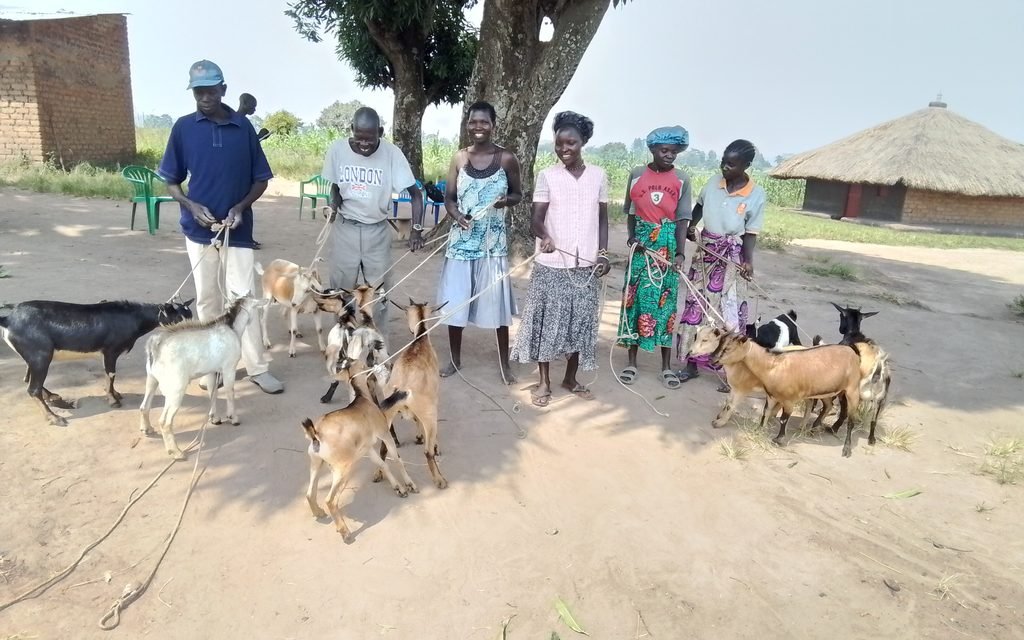
In July 2025, 20 members (eight men and 12 women), despite difficult household economic circumstances, pooled UGX 1,020,000 from their individual savings and purchased six female goats. This marked the beginning of their collective investment.
For the community, the initiative represents an opportunity to demonstrate the value of collective ownership and accountability. One Local Council (LC) I member observes that although several government programmes, including the National Agricultural Advisory Services (NAADS), Northern Uganda Social Action Fund 1 (NUSAF 1) and the ongoing Parish Development Model (PDM), had been implemented in the area, interventions had largely focused on individual beneficiaries rather than strengthening collective ownership, group monitoring and accountability. In their view, this limited visible, tangible transformation at the household level.
For the VSLA members, the growth of their goat enterprise represents more than an increase in livestock assets. It reflects a change in how they understand shared responsibility, ownership and accountability. Unlike some previous projects registered in the group’s name but effectively managed as individual property, members say the current approach has strengthened their sense of collective responsibility and stewardship.
One group member explains:
“The LABE HLC approach is teaching us a lot. We have learnt a new principles: ‘It is ours, not mine or yours’. The small contribution each person makes is what keeps everyone alert and committed to monitoring the goats.”
Through commitment, vigilance and proper management, the group has successfully increased its goat population from six to twelve within one year, an achievement the members describe as surprising.
Building on this progress, the group has set a target of expanding its enterprise to 30 goats by November 2027. As part of this plan, members intend to purchase six additional goats worth UGX 1,080,000 in November 2026 through LABE’s livelihood support.
Importantly, the group’s ambitions extend beyond growing its livestock assets. Members have also committed to supporting children’s development at their HLC. By November 2027, they plan to allocate 40% of the goats to support HLC Early Childhood Development (ECD) activities, while the remaining 60% will benefit the enterprise group members.
The Minga experience shows how collective savings, peer learning, and shared accountability can help communities build sustainable livelihood initiatives while contributing to the development of their children’s learning environments.
Read more about LABE’s VSLA+ initiative here.