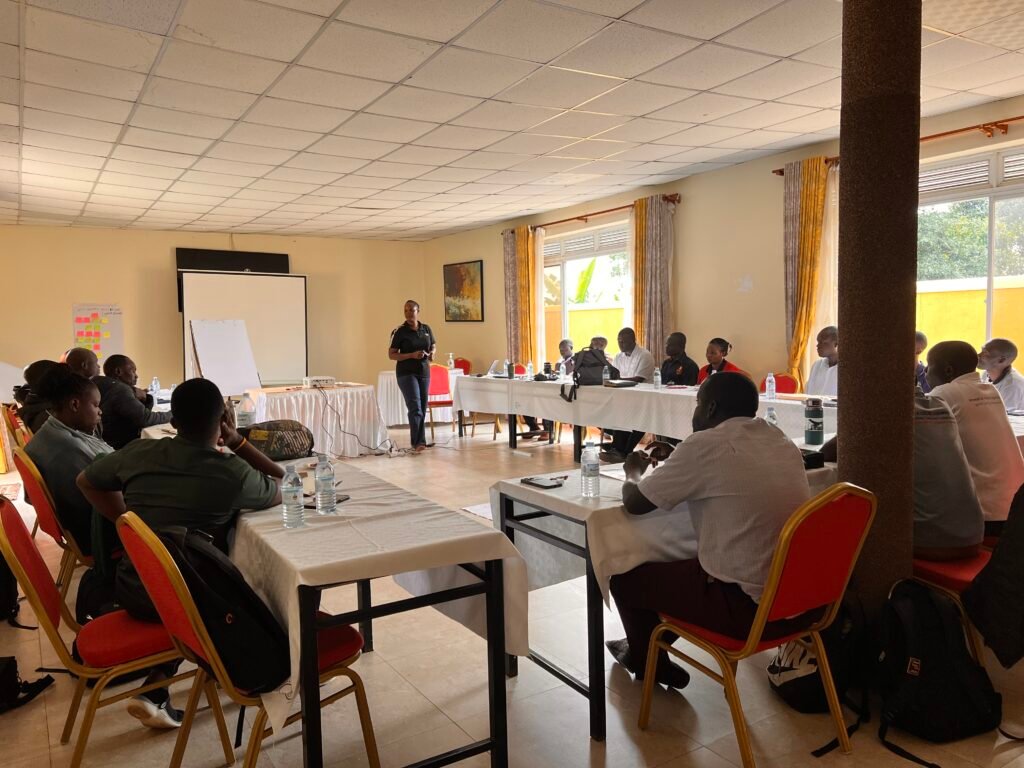
Communities are at the heart of sustainable development. To strengthen this commitment, LABE staff from across our field locations converged in Koboko District for a Participatory Programming (PAPRO) capacity-building training, equipping them with practical approaches to engage communities as active partners throughout the programme cycle.
The training introduced staff to the principles and tools of participatory programming, with a strong emphasis on meaningful community engagement, shared decision-making, inclusion, accountability, and locally led solutions. Through interactive discussions and group exercises, participants reflected on their own programming experiences and explored ways to ensure that the voices of children, caregivers, and communities shape the design, implementation, monitoring, and evaluation of our work.
A lesson from experience
For some participants, the training surfaced hard lessons from past projects. Amule Saidi, a Programme Officer (P.O) operating in Obongi, recalled a project where a water need was identified but the community was not consulted on how to meet it.
“PAPRO enabled me to be sensitive to community needs, ideas, and their suggestions in trying to solve their own problems. Before, while doing shelter construction, we saw a water need at the centres, but we didn’t engage the community to get their suggestions. If we had done PAPRO, we wouldn’t have procured water tanks. The community later told us it would have been better to lay pipes and tap water from existing pipelines passing near the HLCs. That was a big lesson that can be used in planning and implementation going forward.”
The example illustrates a core PAPRO principle: communities often already understand their challenges, and their solutions, better than an outside programme design can anticipate.
Learning put into action

Following the training, staff worked alongside local communities to pilot the PAPRO methodology in real-life settings, facilitating conversations at Diobe, Nyeite, and Tanyaji Home-Based Learning Centres (HLCs) in Koboko District. The field practicum gave staff a chance to apply the tools they had just learned, such as the Problem tree analysis and Stakeholder mapping, and to gain firsthand experience creating safe spaces where community members could identify priorities, analyse challenges, and contribute to decisions that affect their lives.
For Loyce Ayikoru (P.O, Yumbe), PAPRO shifted two habits at once.
“Before the training, I did not mind so much about gender, since women are more active than men. Now I actively include men, women, girls, and boys in planned activities, so gender roles are shared for sustainability. I also changed how I approach material development, such as making dolls, balls, and skipping ropes with village savings and loans association (VSLA) members. PAPRO is telling us to start with parents’ experience, since they are experts in their own communities. During community dialogue meetings, I first engage community members to identify their own problems, possible solutions, and where to tap resources from, and I come in only to guide where necessary.”
For Mawa Jackson (P.O, Koboko), the training reshaped how he identifies Parent Educators (PEs) at his centre.
“PAPRO has made me learn that what works well is what the community suggests. For example, I am using the Centre Management Committees (CMCs) and Local Councils (LCs) to identify Parent Educators at the centre, because they know them very well and can forward the right names.”
Godfrey Andriaku (P.O, Yumbe) ties the same lesson directly to LABE’s programme areas:
“It has provided valuable insights into how these approaches can enhance LABE’s community-based interventions, particularly the establishment and sustainability of Home Learning Centres, as well as initiatives such as VSLAs and micro-enterprises.”
Kau Derrick (Monitoring, Evaluation and Learning (MEL) Officer, Koboko) sums up the shift simply:
“I understood that working with communities, rather than working for them, is the best way to get better results and make them own the work and its results.”
What this means for LABE’s programming
For many participants, the experience reinforced the fact that effective programming begins with listening. It also demonstrated how participatory approaches build trust, strengthen accountability, and foster community ownership, laying the foundation for interventions that are more relevant, inclusive, and sustainable.